
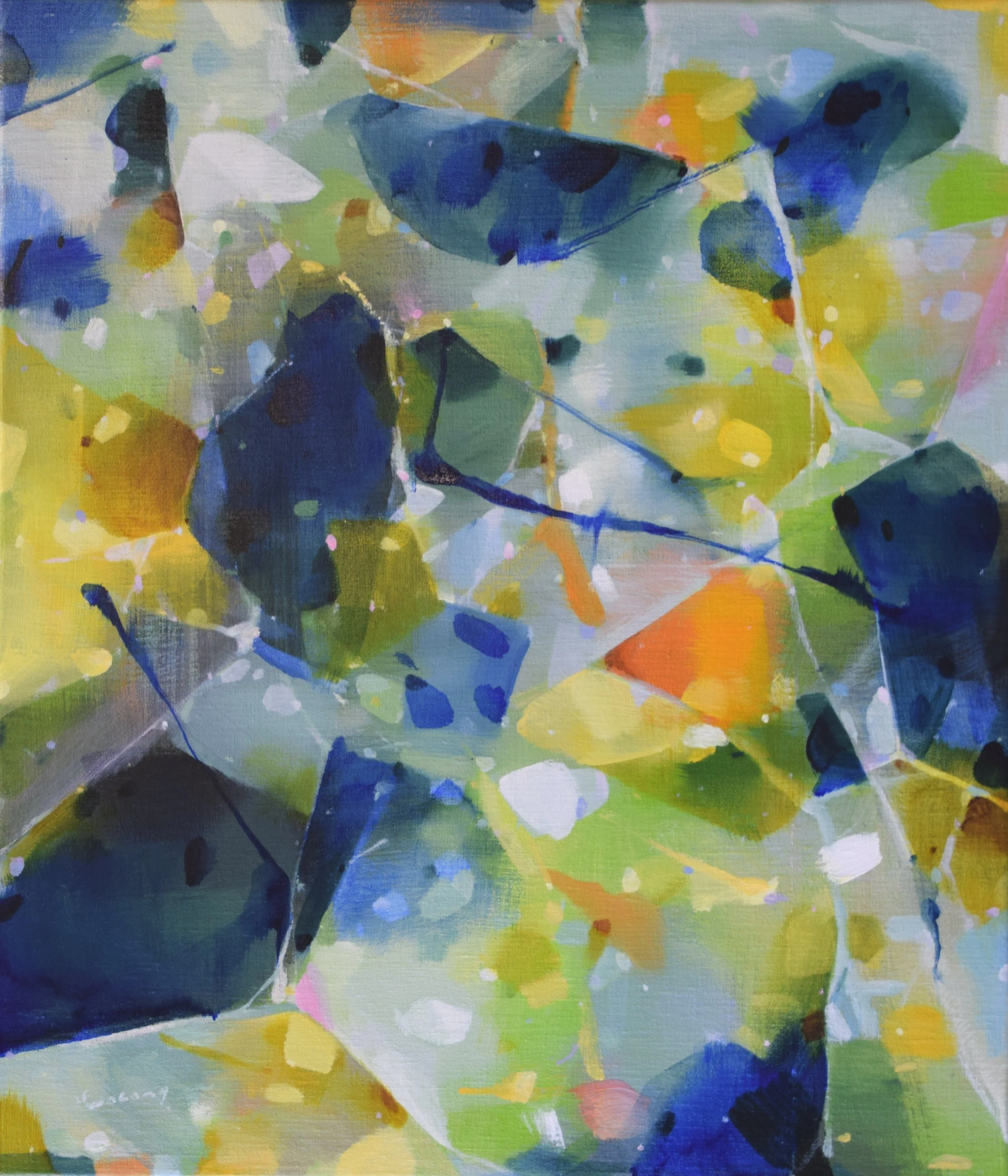
My practice is grounded in a non-narrative visual perceptual structure. The forms, colors, and brushstrokes within the painting do not point toward fixed referents; instead, they function as a system of continuously shifting signifiers, within which meaning is perpetually deferred, displaced, and generated. Viewing thus moves beyond the act of decoding symbols and becomes an experiential process—one that enters the painting and operates alongside it.
Within this structure, light does not arrive from an external source but emerges from within the image itself, forming layered fields of inner luminosity. This light is neither symbolic nor descriptive; rather, it acts as a form of attraction. Like phototaxis in living organisms, it draws the viewer closer, inviting moments of pause and movement across the painting’s layered space. Seeing becomes an act of moving toward light, rather than being directed toward a single focal point.
My work draws inspiration from the taidian (moss dots) of traditional ink painting, which I transform into nodes of visual signal. These nodes function both as traces of gesture and as anchors of perception, carrying the sedimentation of time and the rhythm of space. When expanded into circular or hollow forms, they become zones of pictorial blankness and passages—like cavities in stone or openings in a forest—guiding the viewer into the painting’s internal layers of light.
Through repeated layering and adjustment, the work gradually develops into a state akin to a “spacetime crystal”—one that oscillates cyclically through time while continuously generating itself in space. Rather than offering a singular path of viewing, the painting opens a visual field that can be entered, sensed, and inhabited, unfolding between nodes, layers of light, and subtle fractures.